8 Regrets After Moving to Hawaii: Expectations vs. Reality and How to Check First
academia-admin
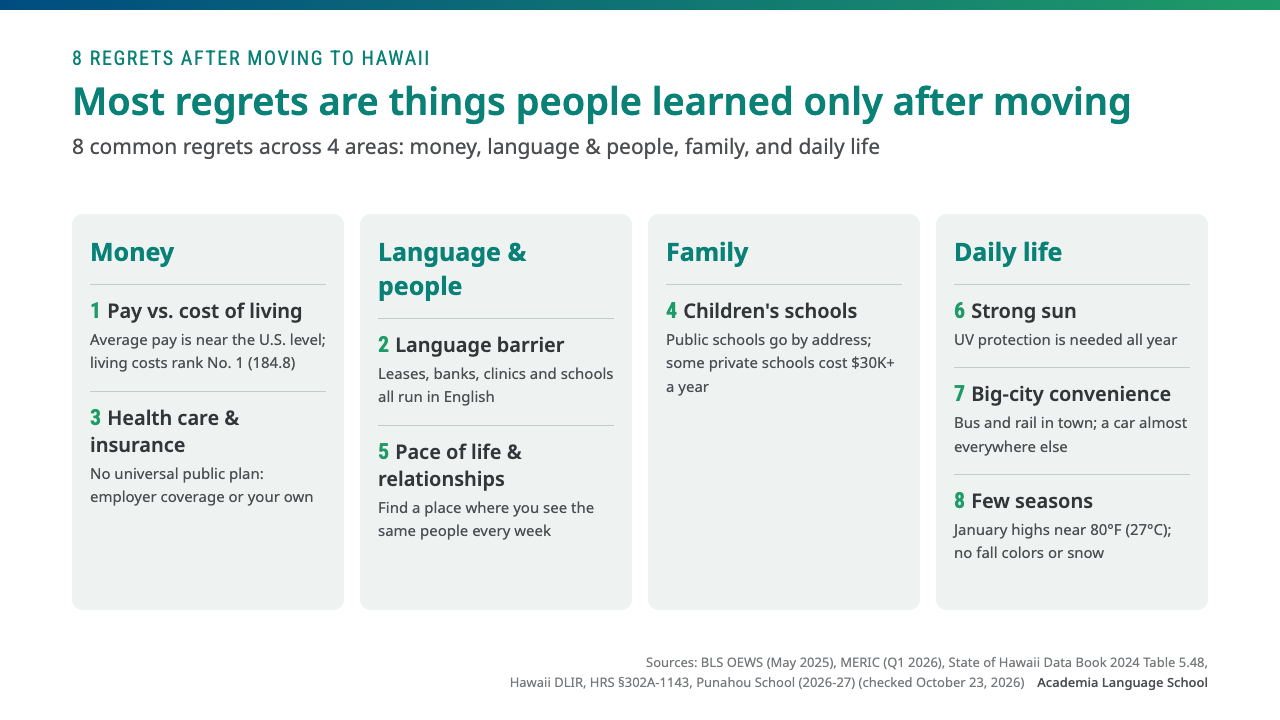
The eight things people most often regret after moving to Hawaii are (1) pay at the U.S. level but the highest cost of living in the country, (2) the language barrier, (3) health care and insurance, (4) children’s schools, (5) the pace of life and relationships, (6) strong sun, (7) less big-city convenience, and (8) few seasonal changes. For example, Hawaii’s mean annual pay is $70,270, almost the same as the U.S. figure ($69,770), yet its cost-of-living index is 184.8 against a U.S. average of 100 (U.S. Bureau of Labor Statistics, May 2025; MERIC, Q1 2026). Each regret comes from something people learned only after moving, so living here briefly before you commit can shrink most of them. In this article, the Academia Editorial Team walks through the eight regrets, the gap between expectations and reality, and how to check before you move, based on official statistics and rules (as of October 23, 2026; all amounts in U.S. dollars).
Written by the Academia Editorial Team / Supervised by Yamahi (School Owner, Academia Language School)
What do people most often regret after moving to Hawaii?
The short answer: eight regrets across four areas — money, language and people, family, and daily life. None of them is easy to see on a few days’ vacation; most people notice them only after several months of living here.
Eight common regrets after moving to Hawaii (compiled by the Academia Editorial Team from BLS, MERIC, MIT, the State of Hawaii Data Book, Punahou School and other sources)
Money: (1) pay vs. cost of living, (3) health care and insurance
Language and people: (2) the language barrier, (5) the pace of life and relationships
Family: (4) children’s schools
Daily life: (6) strong sun, (7) less big-city convenience, (8) few seasonal changes
Is it true that prices are high but pay is not?
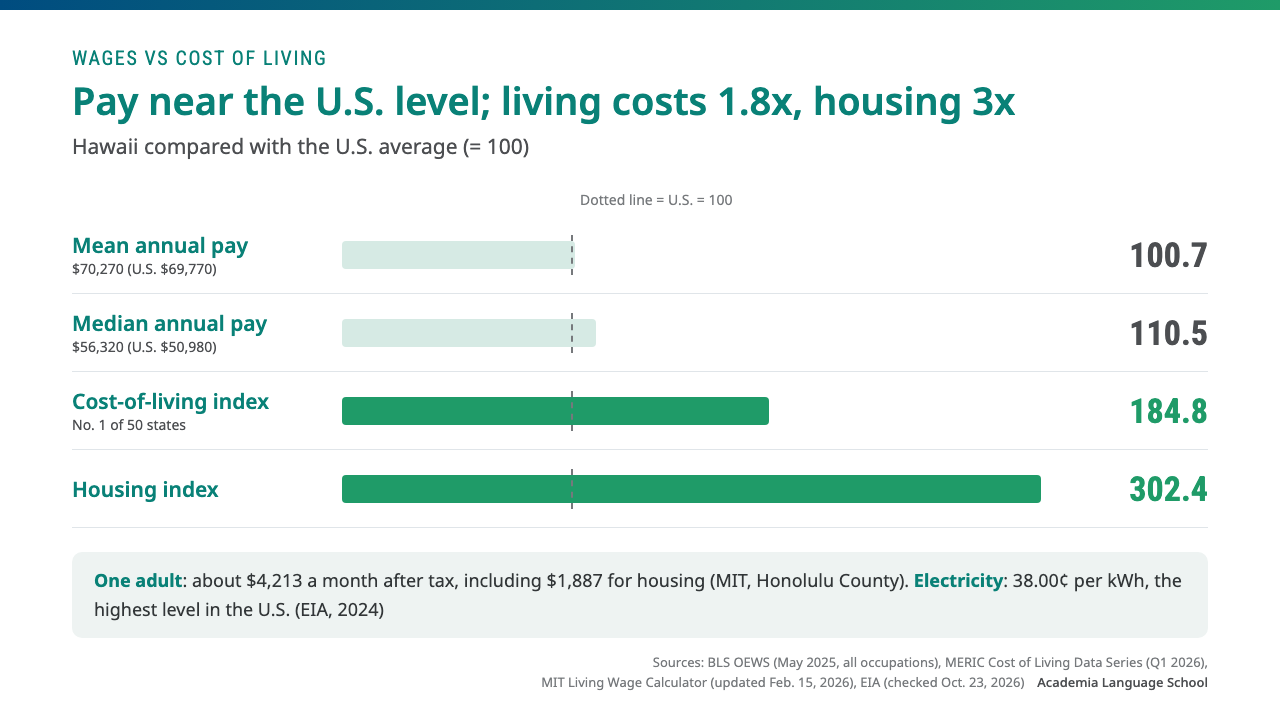
Yes. Pay is close to the U.S. average, while living costs are 1.8 times the U.S. average and housing is 3 times.
Pay and living costs in Hawaii compared with the U.S. (compiled by the Academia Editorial Team from BLS OEWS, May 2025, and MERIC, Q1 2026)
Pay: Mean annual pay across all occupations is $70,270 in Hawaii and $69,770 nationwide; the median is $56,320 in Hawaii and $50,980 nationwide (BLS OEWS, May 2025)
Cost of living: Hawaii’s cost-of-living index is 184.8, No. 1 of the 50 states, and its housing index is 302.4 (MERIC, Q1 2026; U.S. average = 100)
One adult: A single adult in Honolulu County needs $50,553 a year after tax (about $4,213 a month), including $1,887 a month for housing (MIT Living Wage Calculator, updated February 15, 2026)
Electricity: The 2024 average was 38.00 cents per kWh, the highest level in the U.S. (U.S. Energy Information Administration)
People who arrive thinking “my savings plus a local income will be enough” are the ones whose plans most often break down over rent and electricity. Before you move, decide your household size and the area you want to live in, then start from what goes out every month.
Yamahi
I often hear from people who moved here that “more money goes out than we expected.” The first few months are especially heavy, with one-time costs like furniture, a car and a deposit all at once. If you set aside a cushion for the first six months on top of your monthly budget, you keep some peace of mind too.
If my English is limited, where will I struggle?
Not in sightseeing, but in the paperwork of daily life. Some tourist areas offer help in other languages, but everyday procedures assume English.
Where you need English: Leases, bank accounts, electricity and internet contracts, clinics, car registration and communication with your children’s school all happen in English, and the documents arrive in English
How it turns into regret: Signing contracts you don’t fully understand or delaying procedures because you couldn’t ask again — when these add up, daily life starts to feel insecure
How to prepare: Many people focus on the English they need for daily procedures just before or right after moving
Do people regret the pace of life or relationships?
Some do. But it’s not that people in Hawaii ignore time — the sense of time depends on the setting. The relaxed atmosphere is sometimes called “island time,” and a repair worker’s arrival or a government office can feel slower than you are used to. Work, school and medical appointments, on the other hand, run on time.
Relationships: Hawaii is home to people from many cultures, and greetings and personal space are relaxed. Because the steps to becoming close may differ from what you know at home, some people go through a period of feeling they “can’t make friends”
Avoiding isolation: Finding a place early — school, work or a community activity — where you see the same people every week helps you settle in faster
Yamahi
Watching our language school students, classmates are often their first friends here. Seeing people of different countries and ages every day, they pick up not only English but also the sense of distance in relationships in Hawaii.
How can I avoid regrets about health care and my children’s schools?
Check insurance and school zones before you choose a home. Both are hard to change once you have settled in.
Health care: The U.S. has no universal public health insurance. Hawaii’s Prepaid Health Care Act requires employers to provide health coverage for employees working 20 or more hours a week, and the employee’s share is capped at the lesser of 50% of the premium or 1.5% of monthly wages (Hawaii DLIR). People who are not employed, including students, arrange their own insurance
Public schools: Your address determines your school (HRS §302A-1143). To attend a school outside your area, you apply for a Geographic Exception (GE); applications for the next school year run January 1 to March 1 (Hawaii State Department of Education). Requests depend on available space
Private schools: For example, Punahou School’s 2026-27 tuition is $34,230 a year (Punahou School, “Tuition and Financial Aid”). Admission includes testing and interviews
Grade levels: The school year starts in August, and grade placement may differ from your home country
Another option is for a parent to study on a student visa (F-1) while the children, as F-2 dependents, attend local elementary or secondary schools (8 CFR 214.2(f)(15)).
How different are the sun, city convenience and seasons?
Warm with strong sun all year, a car outside the urban core, and little seasonal change. What feels like a perk on vacation can feel limiting or tiring when it is every day.
Temperature: Normals at Honolulu airport are a high of 26.9°C (80°F) and low of 19.3°C (67°F) in January, and a high of 31.6°C (89°F) and low of 24.2°C (76°F) in August. Rainfall is about 417 mm (16 in.) a year, lower on the leeward coast (State of Hawaii Data Book 2024, Table 5.48; 1991–2020 normals)
Sun: You need UV protection all year. On the U.S. EPA’s UV Index, 8 or higher is “very high to extreme” and calls for extra protection. Make it a habit to check the UV index in the forecast and use sunscreen, a hat and shade accordingly
Getting around: In the urban core you can live with the bus (TheBus) and rail (Skyline). With a HOLO card, a 2-hour pass is $3 and a monthly pass is $90 (TheBus “Fares,” revised July 1, 2026). Outside the core, a car becomes a necessity and costs rise
Seasons and free time: There are no cherry blossoms, fall colors or snow. Weekends tend to revolve around the ocean and mountains, so people with a hobby or class they can keep up enjoy island life longer
Safety: It varies by neighborhood and time of day. Before choosing where to live, check your own government’s travel advisory and your consulate in Honolulu, and see for yourself how well-lit and busy the streets are at night
How can I check before I move so I won’t regret it?
Don’t move all at once: live here briefly, then spend a year as a student, then consider your next status. All eight regrets become easier to estimate once you have actually lived here.
1. Live here briefly: If your country is in the Visa Waiver Program (ESTA), you can stay up to 90 days per visit. Stay in the area where you’d like to live, not a tourist zone, and check grocery prices, rent, getting around and how the neighborhood feels at night. A short English course of under 18 hours a week can be taken on ESTA (8 CFR 214.2(b)(7)); if your country is not in the program, check visa options with the U.S. embassy or consulate
2. Spend a year as a student: On an F-1 visa, you can live here and study English for the length of your I-20 (two years at Academia). Classes run Monday to Thursday, four days a week. F-1 students may work only on campus, so plan to cover tuition and living costs with your own funds (8 CFR 214.2(f)(9))
3. Consider your next status: Once you have a real feel for daily life, talk with a qualified professional about a longer-term status through work, investment or family
Yamahi
Most of the “I regret it” stories I hear come less from poor preparation than from “deciding without checking.” If you live here for a year and decide home is better after all, that is a valuable answer too. I recommend planning your steps so you can try before you decide.
Summary: most regrets can be checked before you move
Pay is near the U.S. level (mean $70,270); living costs rank No. 1 (184.8; housing 302.4). Plan on about $4,200 a month for one adult
Daily-life paperwork assumes English
The pace of life and relationships may differ from home. Find a place early where you see the same people every week
There is no universal public health insurance. Public schools go by address; some private schools cost over $30,000 a year
Warm with strong sun all year. Bus and rail in the urban core, a car elsewhere. Few seasonal events
Living here briefly, then a year as a student, then your next status — checking in this order shrinks most regrets
Wondering which regret is most likely for you, or where to start if you spend a year here as a student? Contact us — and see How to Apply for the enrollment steps.
Sources: U.S. Bureau of Labor Statistics, Occupational Employment and Wage Statistics (May 2025; mean and median annual wages, all occupations, Hawaii and U.S.); MERIC Cost of Living Data Series (Q1 2026); MIT Living Wage Calculator (Honolulu County, Hawaii, updated February 15, 2026); U.S. Energy Information Administration, “Hawaii State Profile” (2024 data); State of Hawaii Data Book 2024, Table 5.48; Hawaii DLIR, “Prepaid Health Care”; HRS §302A-1143; Hawaii State Department of Education, “Geographic Exception”; Punahou School, “Tuition and Financial Aid” (2026-27); U.S. EPA, “UV Index Scale”; TheBus, “Fares” (revised July 1, 2026); CBP, “Visa Waiver Program”; 8 CFR 214.2(b)(7), (f)(9), (f)(15) (all checked October 13–23, 2026). This article reflects information as of October 23, 2026, and is not legal advice. Visa issuance and admission to the U.S. are decided by U.S. embassies and consulates and CBP; the school cannot guarantee them.