
8 Regrets After Moving to Hawaii: Expectations vs. Reality and How to Check First
academia-admin
Academia Language School

If you are in Hawaii on an F-1 student visa and want to move to a different language school, the process is simple: tell the DSO (Designated School Official) at your current school that you want to transfer, and have your SEVIS record moved to the new school. You do not need a new visa as long as the one in your passport is still valid. Two deadlines matter: start classes at the new school within 5 months, and report to the new school within 15 days of the program start date on your new I-20. In this article, the Academia editorial team explains the conditions, steps and deadlines based on U.S. federal regulations and SEVP (Student and Exchange Visitor Program) guidance, and how Academia Language School accepts transfer students (as of October 9, 2026).
Written by the Academia Editorial Team / Supervised by Yamahi (School Owner, Academia Language School)
Yes. Federal regulations (8 CFR 214.2(f)(8)) state that an F-1 student who is maintaining status may transfer to another SEVP-certified school. The procedure is the same whether you move from one language school to another, or from a college or university to a language school. You do not have to leave the United States; the whole transfer can be done while you stay in Hawaii.
The condition is that you are “maintaining status.” In practice, this means you are attending a full course of study at your current school (for a language school, at least 18 clock hours a week) or have just completed one. Students who complete a program have a 60-day grace period in which they may prepare to leave or arrange a transfer (8 CFR 214.2(f)(5)(iv)). On the other hand, a student whose record has been terminated by the school, for example because of poor attendance, cannot simply transfer. In that case you must apply to USCIS for reinstatement through the new school, which takes time and money.
One more thing to know: the “fixed period of admission” rule published in July 2026 (often called the “four-year rule”) included new limits on transfers, such as not allowing a transfer until you finish the first academic year at your first school and not allowing re-enrollment at the same or a lower program level. That rule was blocked by a federal district court order on September 14, 2026 and is not in effect as of October 9, 2026. The current transfer conditions are the ones described in this article.

Many of the F-1 students who join Academia are transfers from other schools in Hawaii. The question I hear most often is, “Can I quit my current school first and then look for the next one?” The answer is: decide before you quit. Once your record is terminated, it is no longer a transfer but a reinstatement case.
There are five steps. The key date is the “transfer release date” that your current school’s DSO enters in SEVIS. On that date, responsibility for your record moves to the new school.
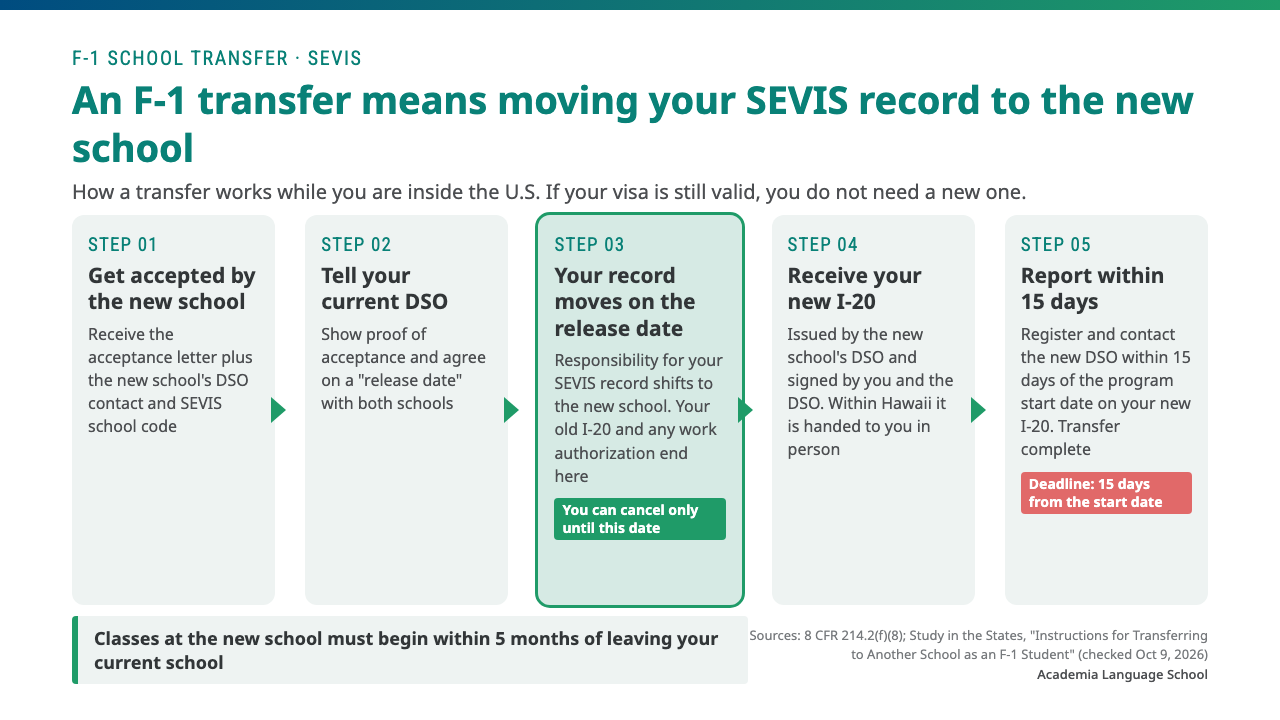
All SEVIS actions are taken by the schools’ DSOs, so there is nothing you need to file on a government website yourself. Your three jobs are: get accepted by the new school, notify your current school, and show up at the new school on time.
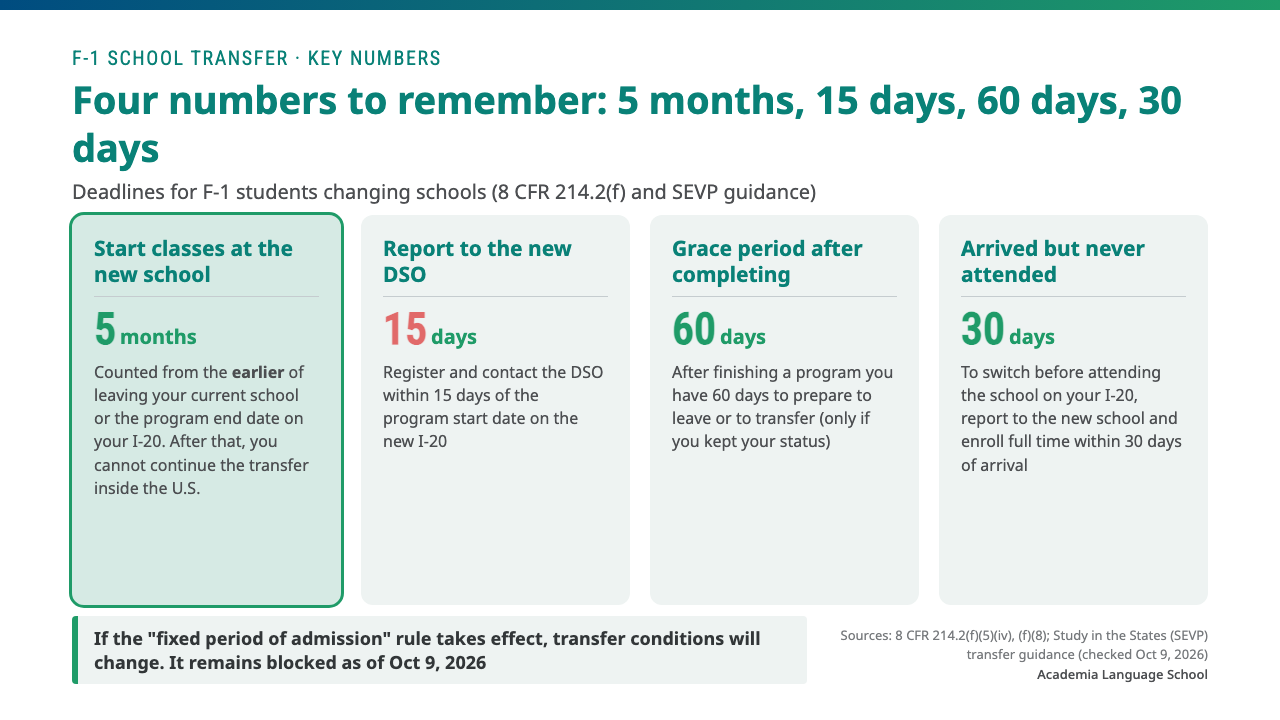
There are four numbers to remember. The most important one is 5 months.
Academia starts new students every Monday, so the most common pattern is to begin on the Monday after your release date. If you line it up with the end of your current school’s term, there is almost no gap in your classes. The release date is something you agree on with your current school, so talk to us before you set it.
If your visa is still valid, you do not need a new one. A visa is permission to enter the United States; your status inside the country is managed through your SEVIS record and I-20. Even if the visa in your passport shows the name of your previous school, you can use it together with the new school’s I-20.
You can also travel to your home country while the transfer is in progress. According to SEVP guidance, if your visa is valid you can re-enter with the new school’s “transfer pending” I-20. If your visa has expired, you apply for a new one at a U.S. embassy or consulate using the new I-20 before returning. In either case, you need the I-20 signed by the new school’s DSO when you re-enter. Keep the I-20 in your carry-on, never in checked luggage.
Academia Language School (Honolulu, Ala Moana) accepts transfer students from other schools. The main documents for transfer students, as listed on the school’s Application Process page (checked October 9, 2026), are:
You apply through the online application form, and the I-20 is issued after payment. If you are transferring between schools in Hawaii, the I-20 is handed to you in person; if you are not in Hawaii, it is sent by email. Enrollment is every Monday (except the last week of each semester and the week before it). Classes follow a four-day week (Monday to Thursday), which satisfies the F-1 attendance requirement, and Academia issues a two-year I-20 regardless of the length of your initial enrollment.
On fees, F-1 transfer students can use the Transfer Campaign, a discount of up to 20% off regular tuition (you must declare it when applying; not available through agents). There is also the Afternoon-Only Classes plan, open only to transfer and current students, which uses the 12:30–3:00 and 3:00–5:30 pm classes with a minimum of 8 weeks. The afternoon plan cannot be combined with the Transfer Campaign. Please check the fee pages on the school website for current prices.
The most common reasons for transferring are the timetable and the number of school days. With a four-day week, Friday becomes your own time, and the afternoon-only plan is popular with parents who do school drop-off in the morning. Tell us what did not work at your current school and we will plan your classes together.
Questions such as “When does my current term end?” or “What release date should I choose?” are welcome. The school cannot guarantee visa approval or immigration status, but we will walk you through the steps and the paperwork.
Sources: 8 CFR 214.2(f)(5)(iv) and (f)(8) (Code of Federal Regulations, 2025 edition); Study in the States (U.S. Department of Homeland Security, SEVP), “Transferring to a Different School,” “Instructions for Transferring to Another School as an F-1 Student,” and “SEVIS Help Hub: Complete Transfer of F-1 SEVIS Record”; Academia Language School website, “Application Process,” “Transfer Campaign,” “Afternoon-Only Classes,” and “Attendance Rate and Forced Expulsion” (all checked October 9, 2026). This article reflects information as of October 9, 2026 and is not legal advice.

