8 Regrets After Moving to Hawaii: Expectations vs. Reality and How to Check First
academia-admin
Academia Language School

The new rule that would cap the stay of F-1 student visa holders at a fixed period, such as “a maximum of four years,” is not in effect as of October 22, 2026. On September 14, 2026, a federal district court postponed the rule’s effective date and barred the Department of Homeland Security (DHS) from implementing it nationwide. The government filed an appeal on September 30, but the appeal does not change the district court’s order. Whether you are already studying on an F-1 visa or planning to come to the United States, your period of stay is still recorded as “D/S,” just as before. In this article, the Academia editorial team explains what the rule says, where the court case stands, and what prospective students should check now.
Written by the Academia Editorial Team / Supervised by Yamahi (School Owner, Academia Language School)
It is a final rule that DHS published in the Federal Register on July 17, 2026 (FR Doc. 2026-14439). Its official title is “Establishing a Fixed Time Period of Admission and an Extension of Stay Procedure for Nonimmigrant Academic Students, Exchange Visitors, and Representatives of Foreign Information Media,” and it was scheduled to take effect on September 15, 2026.
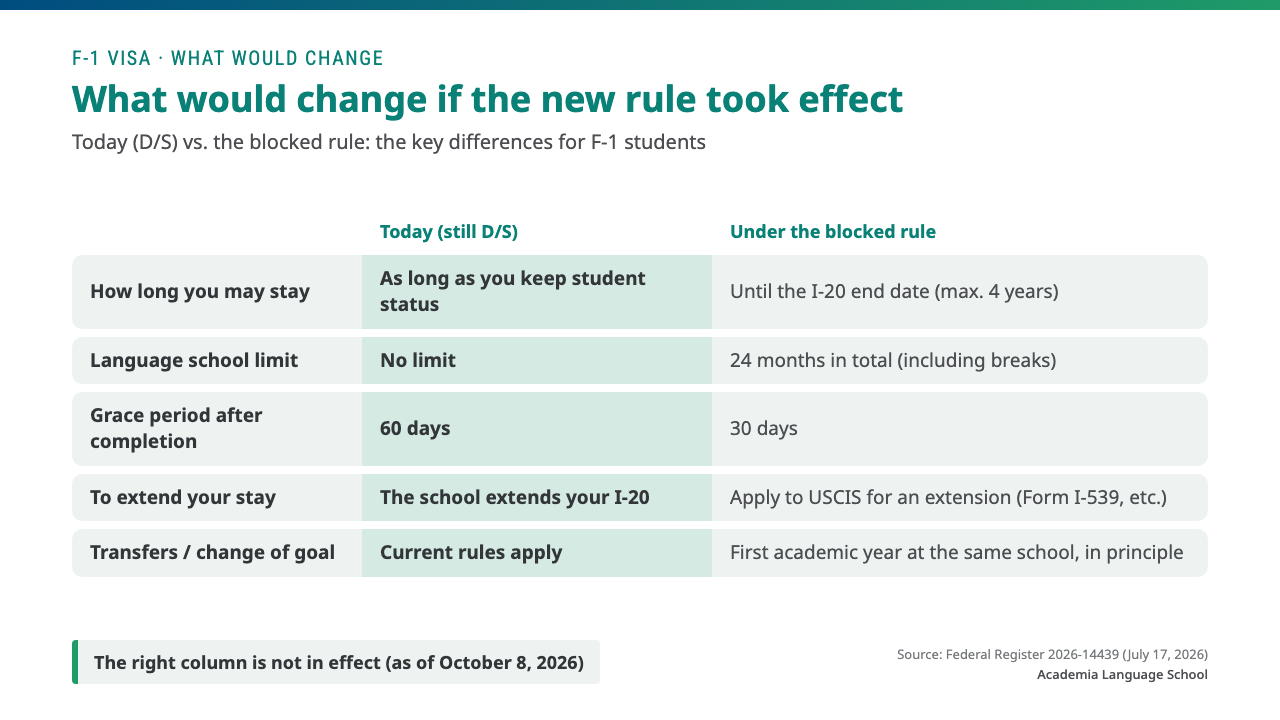
Until now, F-1 students have not been given a specific end date for their stay when they enter the United States. Instead, their admission is recorded as “D/S.” D/S (Duration of Status) means you may remain in the country for as long as you maintain your student status. The document that proves that status is the I-20 (Certificate of Eligibility) issued by your school. The new rule would end D/S and instead admit students for a fixed period: until the program end date on the I-20, up to a maximum of four years.
The rule also includes the following changes (from the summary in Federal Register 2026-14439):
There is also a transition provision for students who are in D/S on the effective date: they would be allowed to continue in D/S until the program end date on their current I-20 (up to four years from the effective date).

For a language school, the biggest change is the 24-month cap. Since the rule was announced in July, I have had many students ask, “What happens if I want to stay longer than two years?”
The answer is: it is blocked by a court order, and D/S remains in place. Here is the timeline.
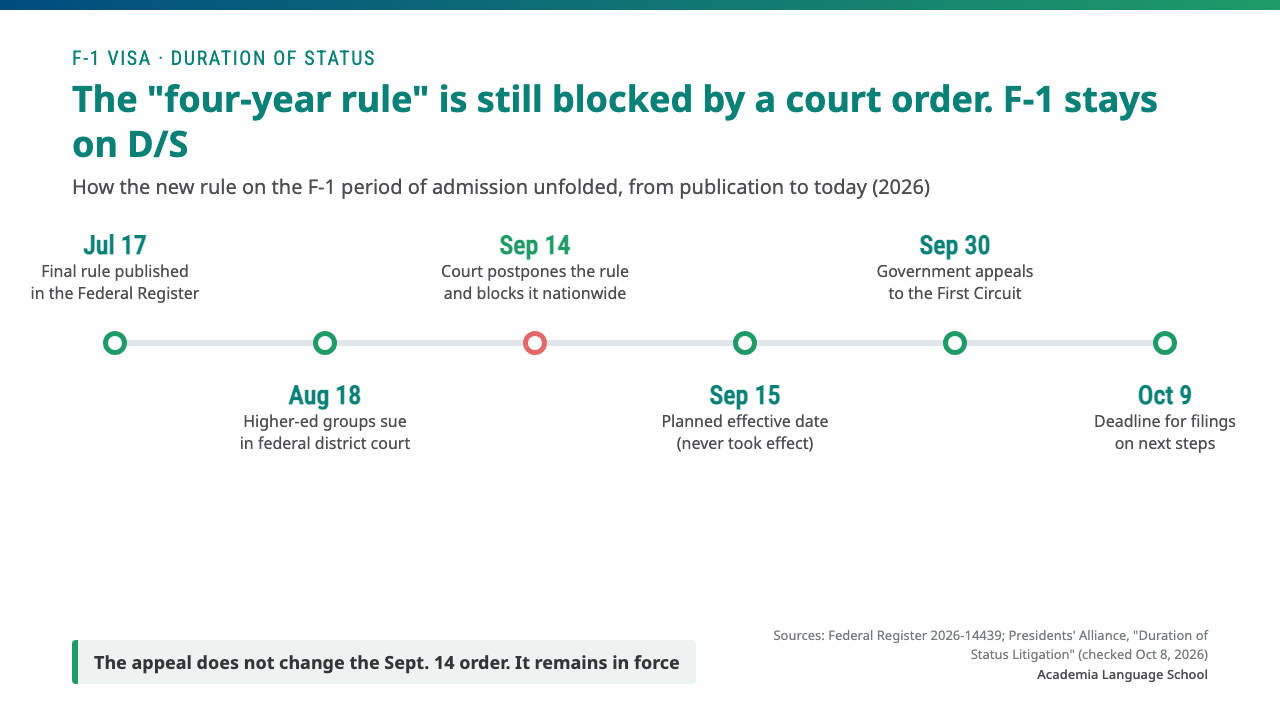
The plaintiffs’ litigation page explains that the appeal “does not put the rule into effect and does not change the district court’s order postponing the effective date.” In other words, the rule stays blocked until the appeals court rules otherwise. When and how the appeals court will decide is not known at this time.
As of October 22, 2026, nothing has changed. None of the rule’s provisions, the four-year maximum, the 24-month limit for language schools, the 30-day grace period, the USCIS extension application, or the transfer restrictions, have taken effect.
That said, the rule could still take effect depending on the outcome of the appeal. To be prepared, it is a good idea to check the following now.
On social media I still see old posts saying the four-year rule has already started. It is on hold. If you are worried, check your I-20 and I-94 together.
Until the outcome of the rule is clear, Academia Language School (Honolulu, Ala Moana) issues a two-year I-20 regardless of the length of your initial enrollment. This is so that, if you later decide to study longer, you are less likely to be affected by an extension procedure.
Academia also offers classes on a four-day week (Monday to Thursday) that meets the F-1 attendance requirement, and new students start every Monday. We welcome transfer students and families studying together (a parent on F-1 with family members on F-2). Visa issuance is decided by the U.S. embassy or consulate, so the school cannot guarantee that a visa will be granted, but we will guide you through the documents and the steps.
It is very common for students who sign up for a short course to decide they want to stay a little longer. If your I-20 is for two years from the start, you will not have to scramble when that happens.
The plaintiffs (Presidents’ Alliance) keep a dated summary of the court case on their litigation page. The full text of the rule is available in the Federal Register. Official guidance for students and schools is posted on DHS’s “Study in the States” website. The next milestones are the parties’ filings due October 9 and how the appeal proceeds after that.
Academia will post updates on this site and on social media if there are developments. We also plan to cover the overall F-1 visa process and how to transfer between schools in Hawaii in future articles on this site.
If you are wondering “What does this mean for me?” or “Is it safe to apply now?”, feel free to contact us. For questions about your individual immigration status, please also consult an immigration attorney.
Sources: Federal Register, “Establishing a Fixed Time Period of Admission and an Extension of Stay Procedure for Nonimmigrant Academic Students, Exchange Visitors, and Representatives of Foreign Information Media” (July 17, 2026, FR Doc. 2026-14439, RIN 1653-AA95); Presidents’ Alliance on Higher Education and Immigration, “Duration of Status Litigation” (checked October 22, 2026). This article reflects information as of October 22, 2026 and is not legal advice.